Square Knot
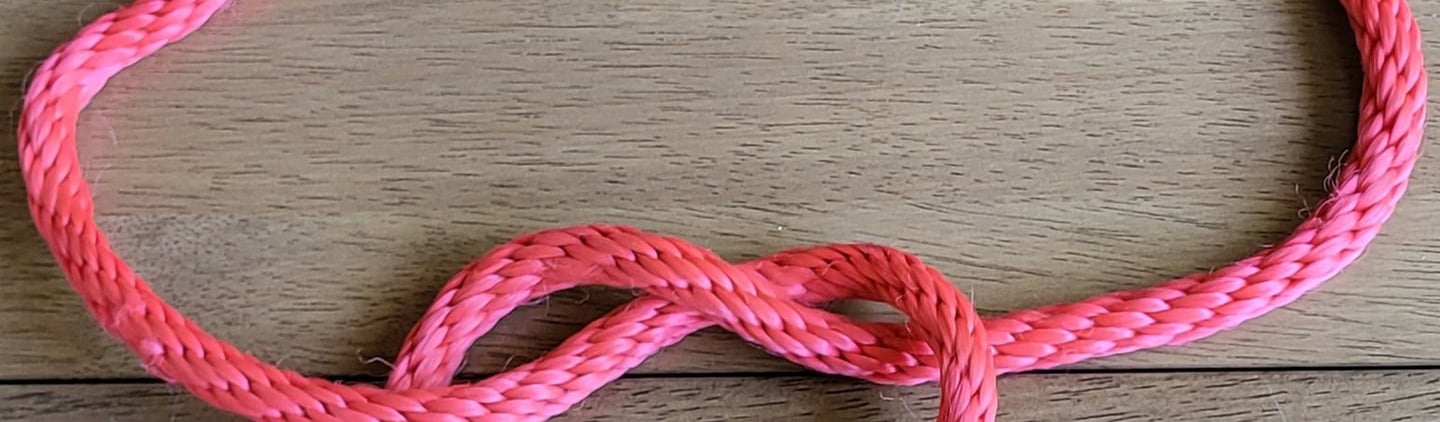
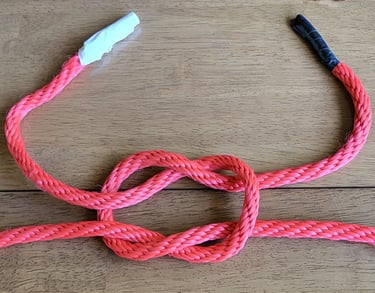
The Square Knot (Ashley Book of Knots #1402), also known as the Reef Knot, is one of the oldest and most widely recognized binding knots in existence. Built by tying a left-handed overhand knot (also known as a half knot in the context of making a bend) followed by a right-handed overhand knot, its symmetrical geometry is designed to secure non-critical bundles or bind light materials. Despite its fame, it is frequently misused as a bend to join two separate ropes together under tension—a dangerous misapplication that easily leads to structural capsizing and complete knot failure.


Applications for Electricians & Construction
On the job site, the Square Knot functions strictly as a light-duty binding knot for non-critical, static securing. Its practical value lies in bundling stationary objects, tying off rag bundles, or securing protective coverings. Its limitations and daily modifications must be strictly observed:
The Double-Slipped Bow (Work Boots): Beyond basic cordage binding, the most universal application of this knot's geometry is the double-slipped square knot. By passing bights (loops) instead of single ends through the second overhand turn, you form the standard shoelace bow used daily on work boots and personal protective equipment, providing reliable holding power with immediate quick-release untying.
Never Use as a Bend: The Square Knot must never be used to join two separate lines that will carry a load or be subjected to dynamic tension. Under load—or when pulled over an edge—the knot easily spills into a lark's head or slips entirely, leading to sudden failure.
Joining Unequal Lines: If tied using ropes of different diameters, stiffnesses, or friction profiles, the knot loses its mechanical balance immediately and will untie itself under minimal tension.


How to Tie the Square Knot
First Overhand: Take the working end in your right hand and cross it over the working end in your left hand ("Right over Left").
Make the Wrap: Tuck the right end under the left end and pull both sides to form a simple single overhand turn.
Second Overhand: Now take the working end that is on your left side and cross it over the working end on your right side ("Left over Right").
Complete the Tuck: Tuck the left end under the right end and pull both working ends away from each other.
Dress and Set: Ensure the working ends exit the knot parallel to their respective standing lines on the same side of the loop. If tied incorrectly ("Right over Right"), you will produce an unstable Granny Knot that slips constantly.
Sunmary and Alternative Options
When secure rope joining or critical binding is required, relying on the Square Knot can put equipment and safety at risk. If you need to join two lines together securely, the Zeppelin Bend provides an ultra-reliable, jam-resistant connection that will not spill under heavy load. For joining lines of unequal thickness or slick synthetic materials, the Fisherman's Knot offers superior security where a Square Knot would fail. And when in search of a parcel trying or bundling solution, the Woodlands Ziptie Knot makes a great replacement.


Square Knot History
The Square Knot dates back thousands of years to ancient Greece, Rome, and early maritime history, where sailors used it to "reef" sails—gathering and tying down excess sail cloth during heavy winds so it could be quickly undone when conditions improved. Its inclusion in early surgical procedures as a suture knot also cemented its place as an essential ancient tie.
Safety Disclaimer: ⚠️ Material Handling Only
The knots and techniques demonstrated on this site are intended strictly for material handling, wire pulling, and equipment securement. > Never use these hitches and knots for life safety, fall protection, or overhead lifting of loads where a failure could result in injury or death. Always use OSHA-compliant, load-rated hardware (harnesses, shackles, and slings) for critical lifts. Your safety team is there for a reason—consult them for high-risk tasks. Master the craft, stay out of pinch points, respect the load, and live to tie knots another day.
Questions or tips? Reach out anytime. I would love to hear about new knots and techniques.
Check out my YouTube channel for knot tying, rigging tips, and other electrician related tutorials.
© 2025. All rights reserved.
I made this website by myself with Hostinger Website Builder. Try it and start building your idea, today.