Arbor Knot Guide: The Go-To Spool-Anchoring Cinch
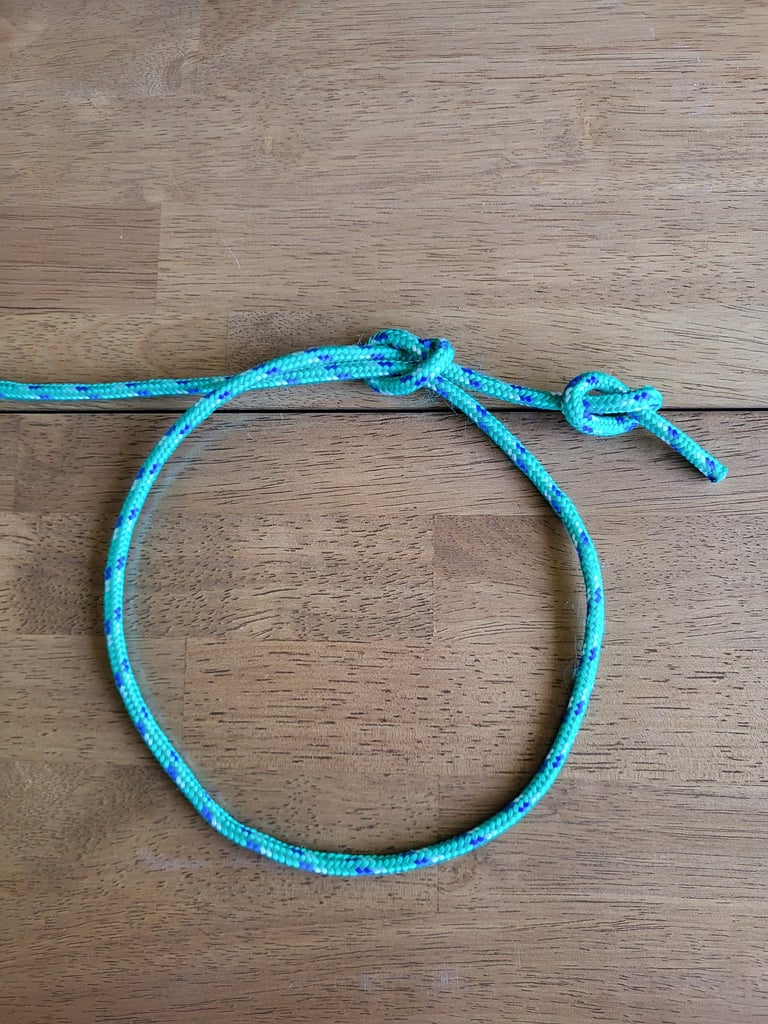

How to Tie the Arbor Knot
Pass the tag end of your rope, jet line, or mule tape completely around the core of your spool, reel, or shaft.
Take the tag end and tie a simple, loose Overhand Knot around the standing line, creating a classic slip-knot structure.
Further down on the remaining tail of the tag end, tie a second, tight Overhand Knot. This second knot serves strictly as a stopper.
Pull down on the standing line to slide the first Overhand Knot, tight against the surface of the spool.
Continue pulling the standing line; the first knot will slide down until it jams solidly against the second stopper knot, locking the loop tightly around the spool core.


The Arbor Knot (also known as the Canadian Zip-Tie, Canadian Jam Knot, or as a Noose Knot in the Ashley Book of Knots as #1114 ) is a simple, light-duty slip-and-lock binding knot. In the broader hierarchy of reverse-friction binding hitches, it is structurally a much weaker zip-tie than heavy-duty options like the Rolling Hitch Zip-Tie, the Woodlands Zip-Tie, or a standard Jam Hitch. However, its simplicity is its greatest strength. Operating on a basic "slip knot locked by a stopper" principle, it is designed specifically to anchor a line to a cylindrical core. It is the absolute perfect knot for securing rope, pull string, or mule tape to a drum, shaft, or spool when you need to wind lines up or transfer conductors to a different size spool.


Uses for Electricians and Construction
While you wouldn't use the Arbor Knot to bind loads under high tension or items with a lot of ring-loading forces, its specific sliding-lock action makes it a highly useful specialty tool in material handling and cable management:
Anchoring Lines to Spools: The absolute best method for tying pull ropes, jet line, or flat mule tape to an empty wooden or plastic spool when transferring line or winding up leftovers.
Consolidating Stranded Wire on Reels: Ideal for securing the starting end of loose, stranded conductors or building wire onto a payout reel, ensuring the wire won't slip around the core when you start cranking.
Zip-Tie: While not the strongest or most secure Ziptie Knot option, it still can be used to temporarily bind together loose material or other non-critical tasks.
Summary and Alternative Hitches
Whether you are consolidating loose pulling lines or swapping a run of conductors onto a more convenient payout spool, the Arbor Knot is a fast, no-fuss solution for anchoring line or wires to a reel. It is an indispensable, light-duty trick that ensures your line grips the core immediately without slipping.
However, if your task requires a binding knot with greater holding power or a different grip profile, you should consider stronger alternatives:
Jam Hitch: A step up in strength, utilizing a slightly modified overhand lock to provide a more secure everyday clamp on material bundles.
Rolling Hitch Zip-Tie: The ultimate choice for securing heavy-duty loads; this heavy-duty, reusable rope zip-tie uses multiple wraps to clamp down hard and prevent slipping under intense, one-way tension.
Woodlands Zip-Tie: For quick-release capability on high-tension wire bundles, this modern trade classic cinches down tightly but can be released quickly for fast unbundling.


History of the Arbor Knot
The Arbor Knot originated in the outdoor sports and fishing industries, where it has served for generations as the standard knot used to anchor slick monofilament or braided line to the arbor of a fishing reel spool. Its alternative names—the Canadian Zip-Tie and Canadian Jam Knot—stem from its widespread use in northern woodcraft as a quick way to lash sleeping bags, canvas rolls, or small bundles of timber together. Over the years, industrial tradesmen adapted this clever reel-fastening technique for utility work. Recognizing that the exact same mechanics used to keep a high-speed fishing line from spinning on an arbor worked flawlessly for anchoring heavy pull-ropes and mule tape to industrial wire reels, electricians integrated it as a standard spooling practice.


Safety Warning: Because the Arbor Knot relies on a simple overhand stopper to resist slipping, it is a low-strength hitch that should never be used for heavy hoisting, critical load-bearing rigging, or wire-pulling runs where high-torque forces are applied.other non-critical tasks.

Safety Disclaimer: ⚠️ Material Handling Only
The knots and techniques demonstrated on this site are intended strictly for material handling, wire pulling, and equipment securement. > Never use these hitches and knots for life safety, fall protection, or overhead lifting of loads where a failure could result in injury or death. Always use OSHA-compliant, load-rated hardware (harnesses, shackles, and slings) for critical lifts. Your safety team is there for a reason—consult them for high-risk tasks. Master the craft, stay out of pinch points, respect the load, and live to tie knots another day.
Questions or tips? Reach out anytime. I would love to hear about new knots and techniques.
Check out my YouTube channel for knot tying, rigging tips, and other electrician related tutorials.
© 2025. All rights reserved.
I made this website by myself with Hostinger Website Builder. Try it and start building your idea, today.